note: Classes discussed in this chapter are located in java.io.
FileReader reader = new FileReader ("input.txt");
int next = reader.read()
char c;
if (next != -1)
   c = (char)next();

   ...

reader.close()
FileWriter writer = new FileWriter("output.txt");
  ...
char c='';
  ...
writer.write(c);
  ...
write.close();
FileInputStream inputStream = new FileInputStream("input.dat");
int next = inputStream.read();
byte b;
if (next != -1)
   b = (byte)next;

      ...

inputStream.close();
FileOutputStream output = new FileOutputStream("output.txt");
  ...
byte b = 0;
  ...
output.write(b);
  ...
write.close();
FileWriter writer = new FileWriter("output.txt");
PrintWriter out = new PrintWriter(writer);
out.println(29.95);
out.println(new Rectangle(5,10,15,25));
out.println("Hello, World!");
FileReader reader = new FileReader ("input.txt");
BufferedReader in = new BufferedReader(reader);
String inputLine = in.ReadLine();
double x = Double.parseDouble(inputLine);
File inputFile = new File("input.txt");
delete
renameTo
exists
FileReader reader = new FileReader(inputFile) ;
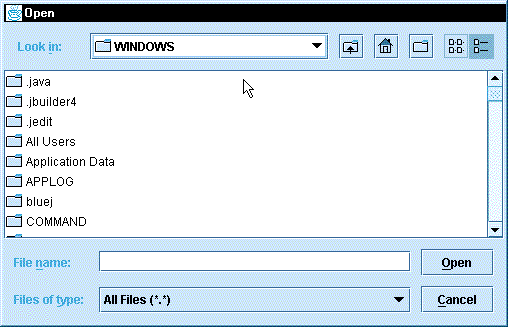
JFileChooser chooser new JFileChooser();
FileReader in = null;
if (chooser.showOpenDialog(null) == JFileChooser.APPROVE_OPTION)
{
    File selectedFile = chooser.getSelectedFile();
    in = new FileReader(selectedFile);
}
note: JFileChooser is in java.io
To encrypt a file means to scramble it so that it is readable only to those who know the encryption method and the secret keyword.
To use Caesar cipher
int next - in.read();
if (next == -1)
   done = true;
else
{
   byte b = (byte)next;
   byte c = encrypt(b);    //call the method to encrypt the byte
   out.write(c)
}
| 1 | import java.io.File; |
| 2 | import java.io.FileInputStream; |
| 3 | import java.io.FileOutputStream; |
| 4 | import java.io.InputStream; |
| 5 | import java.io.OutputStream; |
| 6 | import java.io.IOException; |
| 7 | |
| 8 | /** |
| 9 | An encryptor encrypts files using the Caesar cipher. |
| 10 | For decryption, use an encryptor whose key is the |
| 11 | negative of the encryption key. |
| 12 | */ |
| 13 | public class Encryptor |
| 14 | { |
| 15 | /** |
| 16 | Constructs an encryptor. |
| 17 | @param aKey the encryption key |
| 18 | */ |
| 19 | public Encryptor(int aKey) |
| 20 | { |
| 21 | key = aKey; |
| 22 | } |
| 23 | |
| 24 | /** |
| 25 | Encrypts the contents of a file. |
| 26 | @param inFile the input file |
| 27 | @param outFile the output file |
| 28 | */ |
| 29 | public void encryptFile(File inFile, File outFile) |
| 30 | throws IOException |
| 31 | { |
| 32 | InputStream in = null; |
| 33 | OutputStream out = null; |
| 34 | |
| 35 | try |
| 36 | { |
| 37 | in = new FileInputStream(inFile); |
| 38 | out = new FileOutputStream(outFile); |
| 39 | encryptStream(in, out); |
| 40 | } |
| 41 | finally |
| 42 | { |
| 43 | if (in != null) in.close(); |
| 44 | if (out != null) out.close(); |
| 45 | } |
| 46 | } |
| 47 | |
| 48 | /** |
| 49 | Encrypts the contents of a stream. |
| 50 | @param in the input stream |
| 51 | @param out the output stream |
| 52 | */ |
| 53 | public void encryptStream(InputStream in, OutputStream out) |
| 54 | throws IOException |
| 55 | { |
| 56 | boolean done = false; |
| 57 | while (!done) |
| 58 | { |
| 59 | int next = in.read(); |
| 60 | if (next == -1) done = true; |
| 61 | else |
| 62 | { |
| 63 | byte b = (byte)next; |
| 64 | byte c = encrypt(b); |
| 65 | out.write(c); |
| 66 | } |
| 67 | } |
| 68 | } |
| 69 | |
| 70 | /** |
| 71 | Encrypts a byte. |
| 72 | @param b the byte to encrypt |
| 73 | @return the encrypted byte |
| 74 | */ |
| 75 | public byte encrypt(byte b) |
| 76 | { |
| 77 | return (byte)(b + key); |
| 78 | } |
| 79 | |
| 80 | private int key; |
| 81 | } |
| 1 | import java.io.File; |
| 2 | import java.io.IOException; |
| 3 | import javax.swing.JFileChooser; |
| 4 | import javax.swing.JOptionPane; |
| 5 | |
| 6 | /** |
| 7 | A program to test the Caesar cipher encryptor. |
| 8 | */ |
| 9 | public class EncryptorTest |
| 10 | { |
| 11 | public static void main(String[] args) |
| 12 | { |
| 13 | try |
| 14 | { |
| 15 | JFileChooser chooser = new JFileChooser(); |
| 16 | if (chooser.showOpenDialog(null) != JFileChooser.APPROVE_OPTION) System.exit(0); |
| 17 | |
| 18 | File inFile = chooser.getSelectedFile(); |
| 19 | if (chooser.showSaveDialog(null) != JFileChooser.APPROVE_OPTION) System.exit(0); |
| 20 | File outFile = chooser.getSelectedFile(); |
| 21 | String input = JOptionPane.showInputDialog("Key"); |
| 22 | int key = Integer.parseInt(input); |
| 23 | Encryptor crypt = new Encryptor(key); |
| 24 | crypt.encryptFile(inFile, outFile); |
| 25 | } |
| 26 | catch (NumberFormatException exception) |
| 27 | { |
| 28 | System.out.println("Key must be an integer: " + exception); |
| 29 | } |
| 30 | catch (IOException exception) |
| 31 | { |
| 32 | System.out.println("Error processing file: " + exception); |
| 33 | } |
| 34 | System.exit(0); |
| 35 | } |
| 36 | } |
class MyProgram
{
   public static void main(String[] args)
   {
      ...
   }
}
| args[0] | "-d" |
| args[1] | "file.txt" |
| 1 | import java.io.File; |
| 2 | import java.io.IOException; |
| 3 | |
| 4 | /** |
| 5 | A program to run the Caesar cipher encryptor with |
| 6 | command line arguments. |
| 7 | */ |
| 8 | public class Crypt |
| 9 | { |
| 10 | public static void main(String[] args) |
| 11 | { |
| 12 | boolean decrypt = false; |
| 13 | int key = DEFAULT_KEY; |
| 14 | File inFile = null; |
| 15 | File outFile = null; |
| 16 | |
| 17 | if (args.length < 2 || args.length > 4) usage(); |
| 18 | |
| 19 | try |
| 20 | { |
| 21 | for (int i = 0; i < args.length; i++) |
| 22 | { |
| 23 | if (args[i].charAt(0) == '-';) |
| 24 | { |
| 25 | // it is a command line option |
| 26 | char option = args[i].charAt(1); |
| 27 | if (option == 'd') |
| 28 | decrypt = true; |
| 29 | else if (option == 'k') |
| 30 | key = Integer.parseInt(args[i].substring(2)); |
| 31 | } |
| 32 | else |
| 33 | { |
| 34 | // it is a file name |
| 35 | if (inFile == null) |
| 36 | inFile = new File(args[i]); |
| 37 | else if (outFile == null) |
| 38 | outFile = new File(args[i]); |
| 39 | else usage(); |
| 40 | } |
| 41 | } |
| 42 | if (decrypt) key = -key; |
| 43 | Encryptor crypt = new Encryptor(key); |
| 44 | crypt.encryptFile(inFile, outFile); |
| 45 | } |
| 46 | catch (NumberFormatException exception) |
| 47 | { |
| 48 | System.out.println("Key must be an integer: " + exception); |
| 49 | } |
| 50 | catch (IOException exception) |
| 51 | { |
| 52 | System.out.println("Error processing file: " + exception); |
| 53 | } |
| 54 | } |
| 55 | |
| 56 | /** |
| 57 | Prints a message describing proper usage and exits. |
| 58 | */ |
| 59 | public static void usage() |
| 60 | { |
| 61 | System.out.println |
| 62 | ("Usage: java Crypt [-d] [-kn] infile outfile"); |
| 63 | System.exit(1); |
| 64 | } |
| 65 | |
| 66 | public static final int DEFAULT_KEY = 3; |
| 67 | } |
Coin c = ...;
ObjectOutputStream out = new ObjectOutputStream(new FileOutputStream("coins.dat"));
out.writeObject(c);
ObjectInputStream in = new ObjectInputStream(new FilInputStream("coins.dat"));
Coin c = (Coin)in.readObject();
ReadArrayList a = new ArrayList(); //add many objects to the array list out.writeObject(a);
ArrayList a = (ArrayList)in.readObject();
class Coin implements Serializable
{
   ...
}
| 1 | import java.io.File; |
| 2 | import java.io.IOException; |
| 3 | import java.io.FileInputStream; |
| 4 | import java.io.FileOutputStream; |
| 5 | import java.io.ObjectInputStream; |
| 6 | import java.io.ObjectOutputStream; |
| 7 | import javax.swing.JOptionPane; |
| 8 | |
| 9 | /** |
| 10 | This program tests serialization of a Purse object. |
| 11 | If a file with serialized purse data exists, then it is |
| 12 | loaded. Otherwise the program starts with a new purse. |
| 13 | More coins are added to the purse. Then the purse data |
| 14 | are saved. |
| 15 | */ |
| 16 | public class PurseTest |
| 17 | { |
| 18 | public static void main(String[] args) |
| 19 | throws IOException, ClassNotFoundException |
| 20 | { |
| 21 | Purse myPurse; |
| 22 | |
| 23 | File f = new File("purse.dat"); |
| 24 | if (f.exists()) |
| 25 | { |
| 26 | ObjectInputStream in = new ObjectInputStream |
| 27 | (new FileInputStream(f)); |
| 28 | myPurse = (Purse)in.readObject(); |
| 29 | in.close(); |
| 30 | } |
| 31 | else myPurse = new Purse(); |
| 32 | |
| 33 | // add coins to the purse |
| 34 | myPurse.add(new Coin(NICKEL_VALUE, "nickel")); |
| 35 | myPurse.add(new Coin(DIME_VALUE, "dime")); |
| 36 | myPurse.add(new Coin(QUARTER_VALUE, "quarter")); |
| 37 | |
| 38 | double totalValue = myPurse.getTotal(); |
| 39 | System.out.println("The total is " + totalValue); |
| 40 | |
| 41 | ObjectOutputStream out = new ObjectOutputStream |
| 42 | (new FileOutputStream(f)); |
| 43 | out.writeObject(myPurse); |
| 44 | out.close(); |
| 45 | } |
| 46 | |
| 47 | private static double NICKEL_VALUE = 0.05; |
| 48 | private static double DIME_VALUE = 0.1; |
| 49 | private static double QUARTER_VALUE = 0.25; |
| 50 | } |
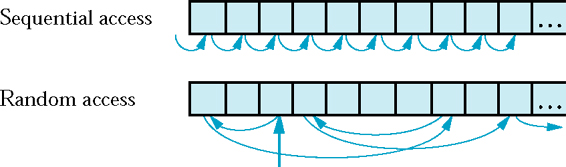
In sequential file access, a file is processed a byte at a time.
Random access allows access at arbitrary locations in the file
RandomAccessFile f = new RandomAcessFile("bank.dat","rw");
f.seek(n);
long n = f.getFilePointer();
long fileLength = f.length();
| 1 | import java.io.IOException; |
| 2 | import java.io.RandomAccessFile; |
| 3 | import javax.swing.JOptionPane; |
| 4 | |
| 5 | /** |
| 6 | This program tests random access. You can access existing |
| 7 | accounts and add interest, or create a new accounts. The |
| 8 | accounts are saved in a random access file. |
| 9 | */ |
| 10 | public class BankDataTest |
| 11 | { |
| 12 | public static void main(String[] args) |
| 13 | throws IOException |
| 14 | { |
| 15 | BankData data = new BankData(); |
| 16 | try |
| 17 | { |
| 18 | data.open("bank.dat"); |
| 19 | |
| 20 | boolean done = false; |
| 21 | while (!done) |
| 22 | { |
| 23 | String input = JOptionPane.showInputDialog( |
| 24 | "Account number or " + data.size() |
| 25 | + " for new account"); |
| 26 | if (input == null) done = true; |
| 27 | else |
| 28 | { |
| 29 | int pos = Integer.parseInt(input); |
| 30 | |
| 31 | if (0 <= POs && POs < data.size()) // add interest |
| 32 | { |
| 33 | SavingsAccount account = data.read(POs); |
| 34 | System.out.println("balance=" |
| 35 | + account.getBalance() + ",interest rate=" |
| 36 | + account.getInterestRate()); |
| 37 | account.addInterest(); |
| 38 | data.write(POs, account); |
| 39 | } |
| 40 | else // add account |
| 41 | { |
| 42 | input = JOptionPane.showInputDialog("Balance"); |
| 43 | double balance = Double.parseDouble(input); |
| 44 | input = JOptionPane.showInputDialog("Interest Rate"); |
| 45 | double interestRate = Double.parseDouble(input); |
| 46 | SavingsAccount account |
| 47 | = new SavingsAccount(interestRate); |
| 48 | account.deposit(balance); |
| 49 | data.write(data.size(), account); |
| 50 | } |
| 51 | } |
| 52 | } |
| 53 | } |
| 54 | finally |
| 55 | { |
| 56 | data.close(); |
| 57 | System.exit(0); |
| 58 | } |
| 59 | } |
| 60 | } |
| 1 | import java.io.IOException; |
| 2 | import java.io.RandomAccessFile; |
| 3 | |
| 4 | /** |
| 5 | This class is a conduit to a random access file |
| 6 | containing savings account data. |
| 7 | */ |
| 8 | public class BankData |
| 9 | { |
| 10 | /** |
| 11 | Constructs a BankData object that is not associated |
| 12 | with a file. |
| 13 | */ |
| 14 | public BankData() |
| 15 | { |
| 16 | file = null; |
| 17 | } |
| 18 | |
| 19 | /** |
| 20 | Opens the data file. |
| 21 | @param filename the name of the file containing savings |
| 22 | account information. |
| 23 | */ |
| 24 | public void open(String filename) |
| 25 | throws IOException |
| 26 | { |
| 27 | if (file != null) file.close(); |
| 28 | file = new RandomAccessFile(filename, "rw");; |
| 29 | } |
| 30 | |
| 31 | /** |
| 32 | Gets the number of accounts in the file. |
| 33 | @return the number of accounts. |
| 34 | */ |
| 35 | public int size() |
| 36 | throws IOException |
| 37 | { |
| 38 | return (int)(file.length() / RECORD_SIZE); |
| 39 | } |
| 40 | |
| 41 | /** |
| 42 | Closes the data file. |
| 43 | */ |
| 44 | public void close() |
| 45 | throws IOException |
| 46 | { |
| 47 | if (file != null) file.close(); |
| 48 | file = null; |
| 49 | } |
| 50 | |
| 51 | /** |
| 52 | Reads a savings account record. |
| 53 | @param n the index of the account in the data file |
| 54 | @return a savings account object initialized with the file data |
| 55 | */ |
| 56 | public SavingsAccount read(int n) |
| 57 | throws IOException |
| 58 | { |
| 59 | file.seek(n * RECORD_SIZE); |
| 60 | double balance = file.readDouble(); |
| 61 | double interestRate = file.readDouble(); |
| 62 | SavingsAccount account = new SavingsAccount(interestRate); |
| 63 | account.deposit(balance); |
| 64 | return account; |
| 65 | } |
| 66 | |
| 67 | /** |
| 68 | Writes a savings account record to the data file |
| 69 | @param n the index of the account in the data file |
| 70 | @param account the account to write |
| 71 | */ |
| 72 | public void write(int n, SavingsAccount account) |
| 73 | throws IOException |
| 74 | { |
| 75 | file.seek(n * RECORD_SIZE); |
| 76 | file.writeDouble(account.getBalance()); |
| 77 | file.writeDouble(account.getInterestRate()); |
| 78 | } |
| 79 | |
| 80 | private RandomAccessFile file; |
| 81 | |
| 82 | public static final int DOUBLE_SIZE = 8; |
| 83 | public static final int RECORD_SIZE |
| 84 | = 2 * DOUBLE_SIZE; |
| 85 | } |