coins.set(4, aNickel);
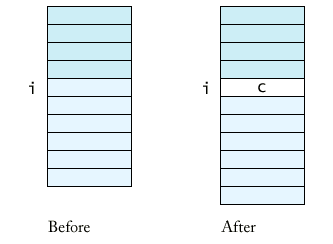
add(i, c)
for (int i = 0; i < coins.size(); i++)
{
   Coin c = (Coin)coins.get(i);
   do something with c
}
| 1 | import java.util.ArrayList; |
| 2 | |
| 3 | /** |
| 4 | A purse holds a collection of coins. |
| 5 | */ |
| 6 | public class Purse |
| 7 | { |
| 8 | /** |
| 9 | Constructs an empty purse. |
| 10 | */ |
| 11 | public Purse() |
| 12 | { |
| 13 | coins = new ArrayList(); |
| 14 | } |
| 15 | |
| 16 | /** |
| 17 | Add a coin to the purse. |
| 18 | @param aCoin the coin to add |
| 19 | */ |
| 20 | public void add(Coin aCoin) |
| 21 | { |
| 22 | coins.add(aCoin); |
| 23 | } |
| 24 | |
| 25 | /** |
| 26 | Get the total value of the coins in the purse. |
| 27 | @return the sum of all coin values |
| 28 | */ |
| 29 | public double getTotal() |
| 30 | { |
| 31 | double total = 0; |
| 32 | for (int i = 0; i < coins.size(); i++) |
| 33 | { |
| 34 | Coin aCoin = (Coin)coins.get(i); |
| 35 | total = total + aCoin.getValue(); |
| 36 | } |
| 37 | return total; |
| 38 | } |
| 39 | |
| 40 | private ArrayList coins; |
| 41 | } |
| 42 |
public class Purse
{
   public boolean find(Coin aCoin)
   {
      for (int i = 0; i < coins.size(); i++)
      {
         Coin c =(Coin)coins.get(i);
         if (c.equals(aCoin)) return true; //found a match
      }
      return false; //no match in the entire array list
   }
   ...
}
public class Purse
{
   public int count(Coin aCoin)
   {
      int matches = 0;
      for (int i = 0; i < coins.size(); i++)
      {
         Coin c =(Coin)coins.get(i);
         if (c.equals(aCoin)) matches++; //found a match
      }
      return matches;
   }
   ...
}
public class Purse
{
   public Coin getMaximum()
   {
      Coin max =(Coin)coins.get(0);
      for (int i = 1; i <coins.size(); i++) // loop starts at 1
      {
         Coin c =(Coin)coins.get(i);
         if (c.getValue()>max.getValue()) max =c;
      }
      return max;
   }
   ...
}
| 1 | import java.util.ArrayList; |
| 2 | |
| 3 | /** |
| 4 | A purse holds a collection of coins. |
| 5 | */ |
| 6 | public class Purse |
| 7 | { |
| 8 | /** |
| 9 | Constructs an empty purse. |
| 10 | */ |
| 11 | public Purse() |
| 12 | { |
| 13 | coins = new ArrayList(); |
| 14 | } |
| 15 | |
| 16 | /** |
| 17 | Add a coin to the purse. |
| 18 | @param aCoin the coin to add |
| 19 | */ |
| 20 | public void add(Coin aCoin) |
| 21 | { |
| 22 | coins.add(aCoin); |
| 23 | } |
| 24 | |
| 25 | /** |
| 26 | Get the total value of the coins in the purse. |
| 27 | @return the sum of all coin values |
| 28 | */ |
| 29 | public double getTotal() |
| 30 | { |
| 31 | double total = 0; |
| 32 | for (int i = 0; i < coins.size(); i++) |
| 33 | { |
| 34 | Coin aCoin = (Coin)coins.get(i); |
| 35 | total = total + aCoin.getValue(); |
| 36 | } |
| 37 | return total; |
| 38 | } |
| 39 | |
| 40 | /** |
| 41 | Counts the number of coins in the purse |
| 42 | @return the number of coins |
| 43 | */ |
| 44 | public int count() |
| 45 | { |
| 46 | return coins.size(); |
| 47 | } |
| 48 | |
| 49 | /** |
| 50 | Tests if the purse has a coin that matches |
| 51 | a given coin. |
| 52 | @param aCoin the coin to match |
| 53 | @return true if there is a coin equal to aCoin |
| 54 | */ |
| 55 | public boolean find(Coin aCoin) |
| 56 | { |
| 57 | for (int i = 0; i < coins.size(); i++) |
| 58 | { |
| 59 | Coin c = (Coin)coins.get(i); |
| 60 | if (c.equals(aCoin)) return true; // found a match |
| 61 | } |
| 62 | return false; // no match in the entire array list |
| 63 | } |
| 64 | |
| 65 | /** |
| 66 | Counts the number of coins in the purse that match |
| 67 | a given coin. |
| 68 | @param aCoin the coin to match |
| 69 | @return the number of coins equal to aCoin |
| 70 | */ |
| 71 | public int count(Coin aCoin) |
| 72 | { |
| 73 | int matches = 0; |
| 74 | for (int i = 0; i < coins.size(); i++) |
| 75 | { |
| 76 | Coin c = (Coin)coins.get(i); |
| 77 | if (c.equals(aCoin)) matches++; // found a match |
| 78 | } |
| 79 | return matches; |
| 80 | } |
| 81 | |
| 82 | /** |
| 83 | Finds the coin with the largest value. |
| 84 | (Precondition: The purse is not empty) |
| 85 | @return a coin with maximum value in this purse |
| 86 | */ |
| 87 | Coin getMaximum() |
| 88 | { |
| 89 | Coin max = (Coin)coins.get(0); |
| 90 | for (int i = 1; i < coins.size(); i++) |
| 91 | { |
| 92 | Coin c = (Coin)coins.get(i); |
| 93 | if (c.getValue() > max.getValue()) |
| 94 | max = c; |
| 95 | } |
| 96 | return max; |
| 97 | } |
| 98 | |
| 99 | private ArrayList coins; |
| 100 | } |
| 101 |
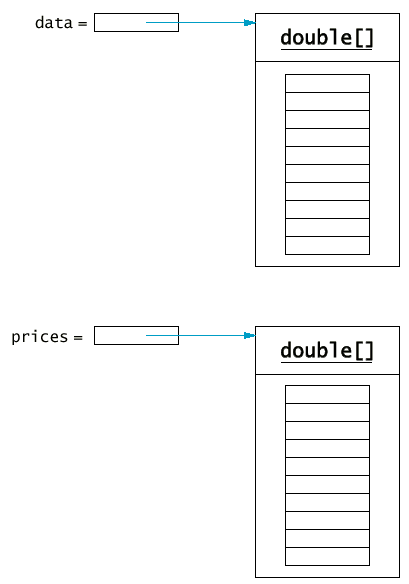
Example:
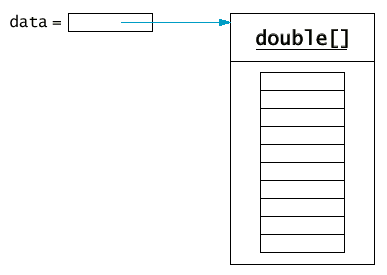
Purpose:To construct an array with a given number of elements. |
Example:
Purpose:To access an element in an array |
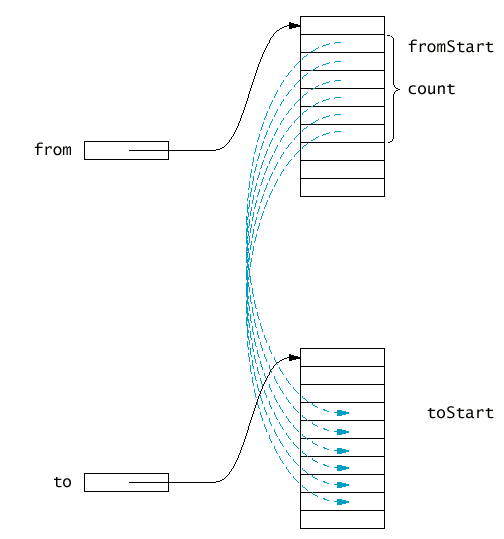
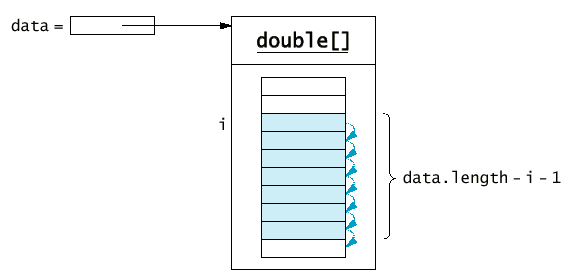
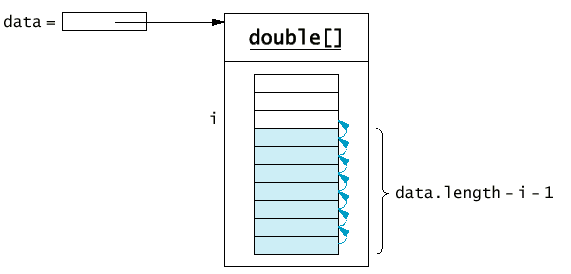
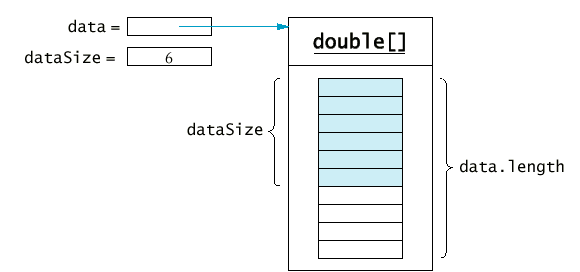
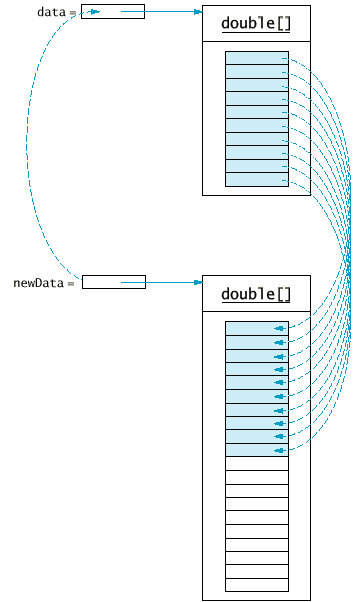
| 1 | /** |
| 2 | This class computes the average of a set of data values. |
| 3 | */ |
| 4 | public class DataSet |
| 5 | { |
| 6 | /** |
| 7 | Constructs an empty data set. |
| 8 | */ |
| 9 | public DataSet() |
| 10 | { |
| 11 | final int DATA_LENGTH = 100; |
| 12 | data = new double[DATA_LENGTH]; |
| 13 | dataSize = 0; |
| 14 | } |
| 15 | |
| 16 | /** |
| 17 | Adds a data value to the data set |
| 18 | @param x a data value |
| 19 | */ |
| 20 | public void add(double x) |
| 21 | { |
| 22 | if (dataSize >= data.length) |
| 23 | { |
| 24 | // make a new array of twice the size |
| 25 | double[] newData = new double[2 * data.length]; |
| 26 | // copy over all elements from data to newData |
| 27 | System.arraycopy(data, 0, newData, 0, data.length); |
| 28 | // abandon the old array and store in data |
| 29 | // a reference to the new array |
| 30 | data = newData; |
| 31 | } |
| 32 | data[dataSize] = x; |
| 33 | dataSize++; |
| 34 | } |
| 35 | |
| 36 | /** |
| 37 | Gets the average of the added data. |
| 38 | @return the average or 0 if no data has been added |
| 39 | */ |
| 40 | public double getAverage() |
| 41 | { |
| 42 | if (dataSize == 0) return 0; |
| 43 | double sum = 0; |
| 44 | for (int i = 0; i < dataSize; i++) |
| 45 | sum = sum + data[i]; |
| 46 | return sum / dataSize; |
| 47 | } |
| 48 | |
| 49 | private double[] data; |
| 50 | private int dataSize; |
| 51 | } |
| 1 | import java.util.Random; |
| 2 | |
| 3 | /** |
| 4 | This program tests the DataSet class by adding 10,000 numbers |
| 5 | to the data set and computing the average. |
| 6 | */ |
| 7 | public class DataSetTest |
| 8 | { |
| 9 | public static void main(String[] args) |
| 10 | { |
| 11 | Random generator = new Random(); |
| 12 | DataSet data = new DataSet(); |
| 13 | final int COUNT = 10000; |
| 14 | System.out.println("Adding " + COUNT + " random numbers."); |
| 15 | for (int i = 0; i < COUNT; i++) |
| 16 | { |
| 17 | double x = generator.nextDouble(); |
| 18 | data.add(x); |
| 19 | } |
| 20 | double average = data.getAverage(); |
| 21 | System.out.println("average=" + average); |
| 22 | } |
| 23 | } |
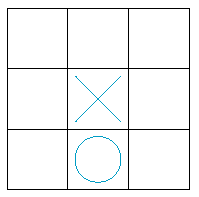
| 1 | /** |
| 2 | A 3 x 3 Tic-Tac-Toe board. |
| 3 | */ |
| 4 | public class TicTacToe |
| 5 | { |
| 6 | /** |
| 7 | Constructs an empty board. |
| 8 | */ |
| 9 | public TicTacToe() |
| 10 | { |
| 11 | board = new char[ROWS][COLUMNS]; |
| 12 | |
| 13 | // fill with spaces |
| 14 | for (int i = 0; i < ROWS; i++) |
| 15 | for (int j = 0; j < COLUMNS; j++) |
| 16 | board[i][j] = ' '; |
| 17 | } |
| 18 | |
| 19 | /** |
| 20 | Sets a field in the board. The field must be unoccupied. |
| 21 | @param i the row index |
| 22 | @param j the column index |
| 23 | @param player the player ('x' or 'o') |
| 24 | */ |
| 25 | public void set(int i, int j, char player) |
| 26 | { |
| 27 | if (board[i][j] != ' ') |
| 28 | throw new IllegalArgumentException("Position occupied"); |
| 29 | board[i][j] = player; |
| 30 | } |
| 31 | |
| 32 | /** |
| 33 | Creates a string representation of the board such as |
| 34 | |x o| |
| 35 | | x | |
| 36 | | o| |
| 37 | @return the string representation |
| 38 | public String toString() |
| 39 | { |
| 40 | String r = ""; |
| 41 | for (int i = 0; i < ROWS; i++) |
| 42 | { |
| 43 | r = r + "|"; |
| 44 | for (int j = 0; j < COLUMNS; j++) |
| 45 | r = r + board[i][j]; |
| 46 | r = r + "|\n"; |
| 47 | } |
| 48 | return r; |
| 49 | } |
| 50 | |
| 51 | private char[][] board; |
| 52 | private static final int ROWS = 3; |
| 53 | private static final int COLUMNS = 3; |
| 54 | } |
| 1 | import javax.swing.JOptionPane; |
| 2 | |
| 3 | /** |
| 4 | This program tests the TicTacToe class by prompting the |
| 5 | user to set positions on the board and printing out the |
| 6 | result. |
| 7 | */ |
| 8 | public class TicTacToeTest |
| 9 | { |
| 10 | public static void main(String[] args) |
| 11 | { |
| 12 | char player = 'x'; |
| 13 | TicTacToe game = new TicTacToe(); |
| 14 | while (true) |
| 15 | { |
| 16 | System.out.println(game); // calls game.toString() |
| 17 | String input = JOptionPane.showInputDialog( |
| 18 | "Row for " + player + " (Cancel to exit)"); |
| 19 | if (input == null) System.exit(0); |
| 20 | int row = Integer.parseInt(input); |
| 21 | input = JOptionPane.showInputDialog( |
| 22 | "Column for " + player); |
| 23 | int column = Integer.parseInt(input); |
| 24 | game.set(row, column, player); |
| 25 | if (player == 'x') player = 'o'; else player = 'x'; |
| 26 | } |
| 27 | } |
| 28 | } |